Pipe Flow
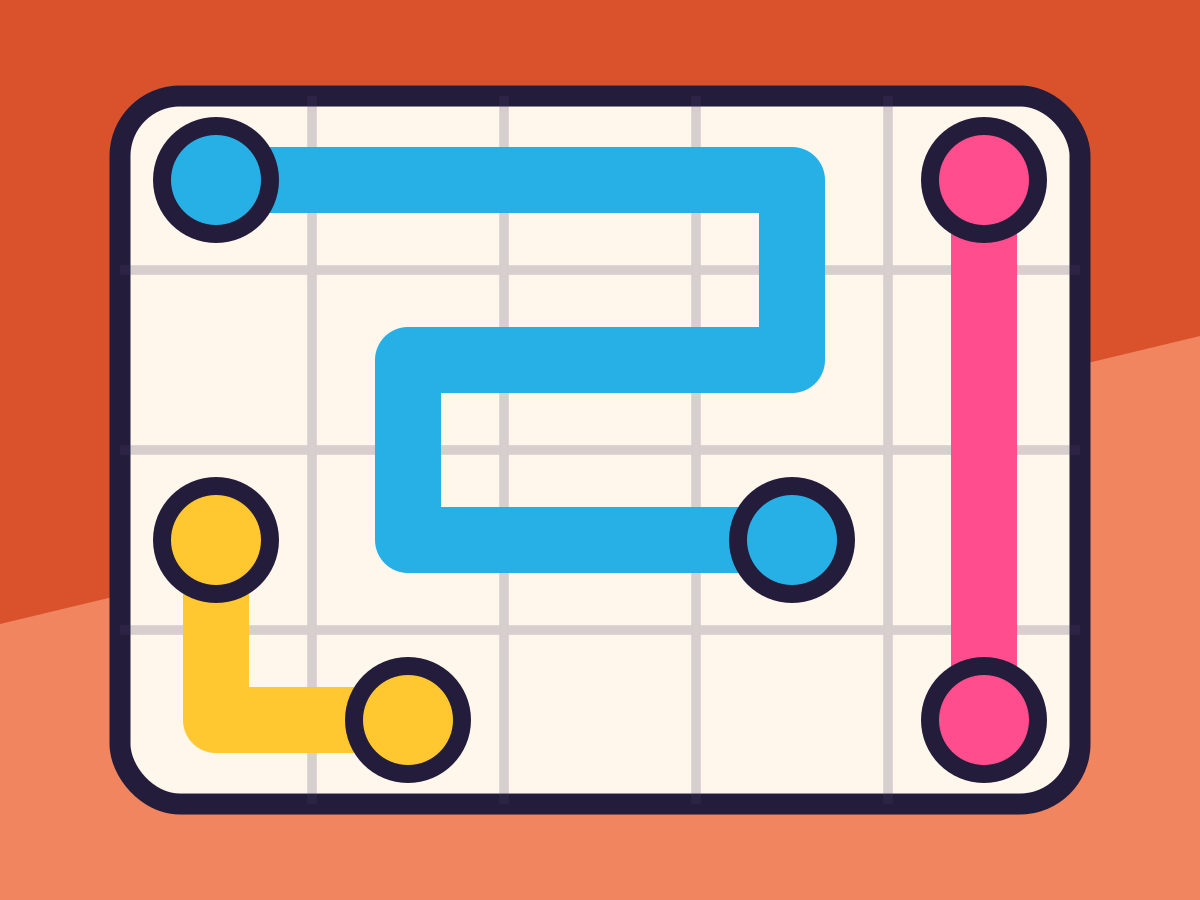
A free pipe puzzle that runs in your browser. Pairs of coloured dots sit on a square grid, and you draw a pipe from one dot to its twin through squares that touch. The board is finished when every pair is joined and every square is covered.
- Free
- No ads
- No account
- No download
- Works offline
- Single player
How do you play?
- Start on a dot - Touch a coloured dot. A pipe can only begin there, never in the middle of the board.
- Move one square - Each further touch steps one square sideways, up or down. Diagonals do not count as touching.
- Close on the twin - Reach the dot of the same colour and the pipe closes. It counts as one move whether it ran three squares or eleven.
- Change your mind free - Touch a colour's dot again and its pipe disappears. Running through another colour cuts that one at the meeting point rather than blocking you.
- Fill the last square - Every pair joined and every square taken. One empty square is enough to leave the board unfinished.
About this game
Touch a dot. Touch the square beside it, then the next one, until you reach the matching dot. Dragging is a shortcut, never a requirement.
The board is not scattered and then hoped over. It starts from an answer. The game traces a single walk that visits every square of the grid exactly once, chops that walk into pieces, one per colour, and the two ends of each piece become a pair of dots. Because those pieces share out a walk that had already covered the whole grid, they cover every square and they have no way to cross. A solution exists before the board is drawn, and nobody had to solve anything to check. The walk is not searched for either. It starts life as a plain row-by-row zigzag and is then folded 9,800 times on the large grid, each fold leaving it still visiting every square exactly once. Across 4,000 dealt boards per level, one pipe runs 6.3 squares on the small grid, 7.2 on the middle one and 8.2 on the large.
The number worth knowing is a different one. On the large grid the two dots of a pair sit 5.1 squares apart as the crow flies, and the pipe that joins them runs 8.2. A detour of 1.61 times. That gap is the puzzle: the squares a straight run skips have to be filled by somebody, and the somebody is usually the pipe you thought would be short. No pair ever has its dots side by side either, in none of the 24,000 hard pairs we counted.
Taking the short way is worse than it looks. A bot that joins each pair by its own shortest route walls a colour in with no free route left on 29.5% of hard boards, and on 17.5% of the easy ones. So the free-looking route is the one to think twice about.
Now the admission. Measured, not guessed. That same shortest-route bot covers 61.2% of a hard board, which leaves nearly four squares in ten bare and the game flatly refuses to end. All it says is that squares are still empty. It does not name the colour that went too straight, there is no hint button anywhere, and a player who has not yet worked out that covering is half the job will read a board that looks finished as a board that is broken.
What does it teach?
Covering a space
Filling a surface with no hole and no square used twice is a piece of geometry this game puts under a finger long before anyone can name it.
Planning a route
A pipe is decided before it is drawn. After a few boards you start looking at where it will have to go rather than at the straight line that jumps out.
Fixing without cost
No mistake here is final. Go back to the dot, the pipe vanishes, and trying something costs exactly nothing.
Counting for real
Knowing four squares are left to cover and the pipe in hand already holds six is arithmetic, and it pays off within the second.
Tips
Corners first
A corner has two neighbours and no more, so a pipe passing through one has to turn there. That is two squares of route you were handed without guessing anything.
The holes are the clue
When everything is joined and a square is still bare, that square names the culprit. The colour running past it is almost always the one that went too straight.
The short way is a trap
Joining every pair by its shortest route strands a colour with nowhere left to go on 29.5% of hard boards. When a route has a choice, take the one that swallows a square nothing else can reach.
Cut without fear
Going through another pipe blocks nothing, it shortens that pipe. Crossing and then redrawing the other colour is usually faster than working out a perfect order.
One colour is a quarter
The longest pipe on a hard board measures 11.2 squares on average, which is 22.8% of the grid. Whoever finds that one first has decided most of the board.
What age is it for?
5 to 6
The 5x5 grid with 4 pairs. Routes there average 6.3 squares, which fits in a head of that age.
7 to 9
The 6x6. Five colours, and the moment a child works out that the bare square in the corner matters as much as the obvious pair.
10 and up
The 7x7 with 6 pairs. A single pipe can run eleven squares here, and the order you lay them in starts to decide the board.
Grown-ups
A hard board in 6 moves, meaning one route per colour and not a single regret. That is rarer than it sounds.
Accessibility
Every square is a real button that announces its own row and column, and a touch alone does everything in the game. Dragging is a shortcut rather than a condition, which matters for a small hand that does not aim well yet and for anyone on an alternative pointer. Enter and the space bar lay a pipe exactly as a finger does, so a whole board can be played from the keyboard. There is no clock and no countdown, and a board you walk away from is exactly where you left it. A move that is not allowed answers with a small shake instead of an error sound, because a refusal is not a telling-off. The eight colours are spread across lightness as well as hue, so two pipes a colour-blind player reads as one hue are still a pale one and a dark one.
Playing together
A colour each
Take turns, one colour per player. You find out quickly that the other person's route went exactly where you were heading.
Say it before you draw it
Call out where the pipe is going, then draw it. A child who can answer that is playing the game rather than following their own finger.
Hunt the holes
Join everything any old way, then look together for the squares left bare. On the large grid it is nearly four in ten, and each one tells the story.
Bet on the longest
Before you start, each of you guesses which colour will end up with the longest pipe. It is a question about reading a grid, and the answer arrives at the end.
Common questions
Is every board really solvable?
Yes, and it is built rather than tested. The game cuts up a walk that had already visited every square, so the pieces cover the grid and cannot cross each other.
Why won't the board finish when everything is joined?
Because a square is still empty. Joining every pair the short way covers only 61.2% of a hard board, and the game is waiting for the ones nothing reached.
What happens if I run through another pipe?
It gets cut at the meeting point and you carry on. Nothing is blocked; the other colour simply has to be drawn again.
Do I have to drag?
No. Tapping square by square does exactly the same thing, and so does the keyboard, and a pipe of eleven squares counts as one move either way.
How many moves is a good score?
As many as there are pairs, so 4, 5 or 6 depending on the grid. Every pipe drawn beyond that count is a change of mind.
Is it free?
Completely. No payment, no ads, and nothing to sign up for.
Does it work offline?
Yes, after one visit. A board in progress is kept too, so closing the tab does not throw it away.
How is the record measured?
In moves, where fewer is better, and separately per grid. Eleven on a 5x5 and eleven on a 7x7 are not the same achievement.