Picture Logic
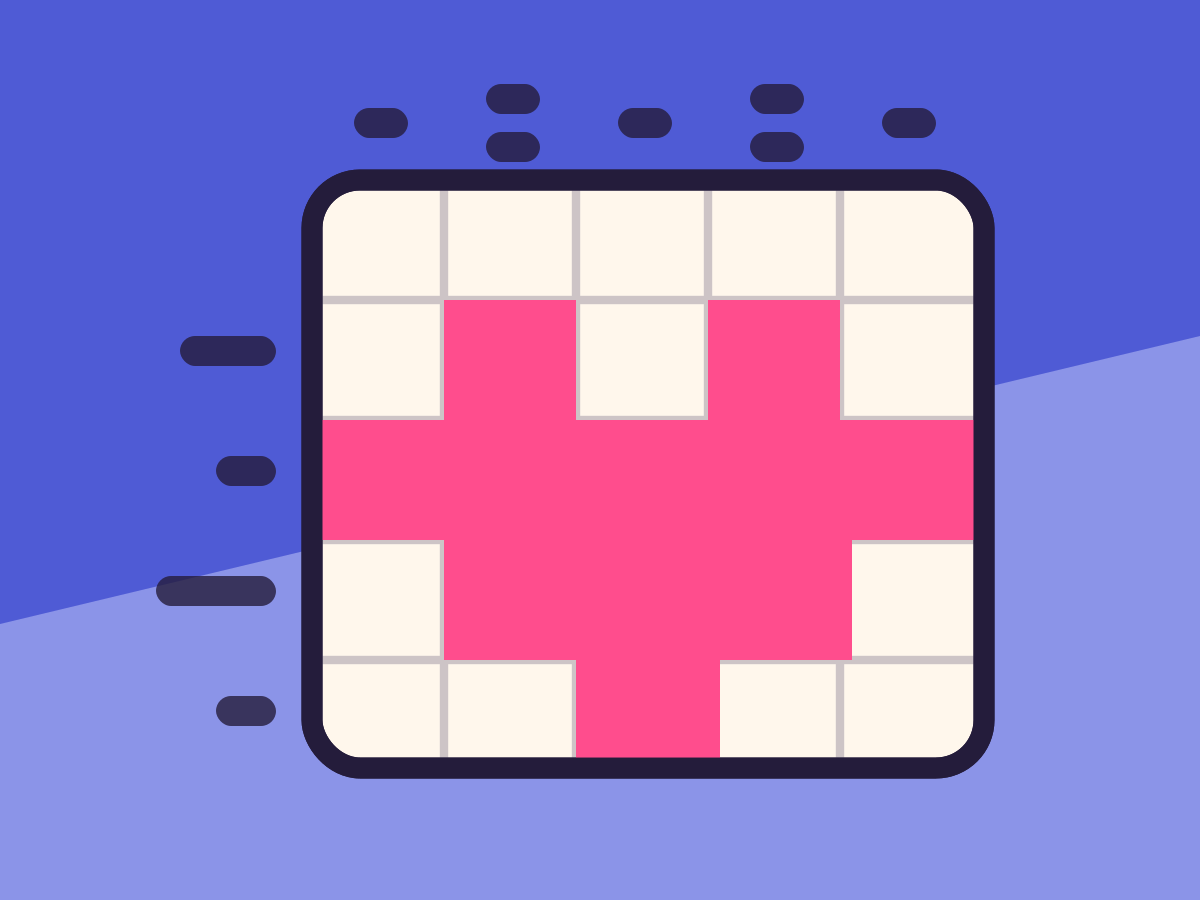
A free picture-logic puzzle that runs in your browser. Every row and every column carries the lengths of its runs of filled cells, and filling the right ones brings a small picture out of the grid. No board here ever needs a guess.
- Free
- No ads
- No account
- No download
- Works offline
- Single player
How do you play?
- Read the numbers - Each row and column carries its run lengths in order. A row marked 4 1 means four filled cells, at least one empty, then one more filled.
- Fill a cell - A tap fills it. The same tap in the same place empties it again, so changing your mind needs no separate control.
- Rule a cell out - The second mode marks a cell as empty. Those are your own notes: the game never asks for them and never checks them.
- Watch what fades - A line's numbers dim the moment that line reads exactly what they say. That is all the feedback there is.
- See the picture - When every row and every column comes out right, the picture is done and the clock stops.
About this game
Read a row. The numbers say how many filled cells run together in it, in order. Fill those. That is the whole game.
The board is not scattered and then checked. It starts as a picture. The game draws one, reads the run lengths off it, and hands those numbers to a line solver that is only allowed to write a cell when every legal arrangement of that line agrees about it. If the solver finishes the whole grid, the numbers force exactly one picture and a player can reach it without guessing once. If it stalls anywhere, the picture is thrown away and another is drawn. Across 4,000 candidate pictures per tier, 87.7% survive that proof on the smallest grid and 82.0% on the largest, so a dealt board costs about 1.25 pictures on average and five in the worst case measured.
The number that says what the game feels like is a different one. A single sweep of every row and then every column settles 85.3% of the smallest grid by itself. On the largest, that same sweep settles 58.2%, and the rest arrives only by reading one axis against the other, over 4.15 sweeps on average and up to 12. The side of the grid tripled. The amount of cross-referencing did a great deal more than triple.
About half the cells end up filled at every size, which is a decision. A board three quarters black is a darker picture, never a deeper puzzle. The largest grid carries 53 numbers around its edges, against 15 on the smallest.
Now the admission. Nothing here tells you a cell is wrong. A line's numbers fade once that line reads exactly what they promise, and that is the entire feedback; a cell filled in error simply sits there until some other line refuses to work out. On the largest grid that surfaces a long way from where the mistake was made. There is no undo history and no button pointing at the guilty line. The way out is to re-read the row and the column through the cell you doubt, and that is a skill this game does not teach you.
What does it teach?
Reading a constraint
A clue of 3 1 is not a quantity, it is a shape, with an order and a compulsory gap inside it. Understanding that is already reading notation.
Crossing two sources
One row alone is almost never enough. The answer comes out of where a row meets a column, the shape of cross-referenced reasoning.
Writing down what is ruled out
Marking a cell empty records a conclusion so it never has to be reached twice. The habit finishes the big grid far faster.
Holding certainty
Because nothing here calls for a bet, every cell placed has been proved. It is a quiet way to learn the difference between knowing and thinking.
Tips
Start with the long run
A run longer than half its line overlaps itself wherever you put it, so part of it is known straight away. The longest run on the largest grid averages 12.8 cells, which is most of a line for free.
Zero is the best number
A line marked 0 is entirely empty, and it cuts every column it crosses. Look for those before you look at anything else.
Rule out as much as you fill
A cell you know is empty is worth exactly as much as a filled one, because it stops a run reaching through it. One sweep settles 58.2% of the largest board, and much of that is cells ruled out rather than filled in.
Change axis the moment you stall
A row that has stopped giving anything has almost always been opened up by a column since you last looked. The game's own solver makes that swap 4.15 times before it is done.
Never guess
No board dealt here needs a bet. If you feel like taking one, the deduction you are missing is somewhere else on the grid.
What age is it for?
6 to 8
The 25-cell grid, with 15 numbers around it. One sweep already settles 85.3% of it, so a child rarely stalls.
9 to 12
The 100-cell grid. Numbers per line drop to 1.27 on average there, which means longer runs and deductions that carry further.
13 and up
The 225-cell grid and its 53 numbers. The first sweep gives only 58.2%; the rest is bought one axis at a time.
Grown-ups
The big grid without ruling out a single cell. Possible, and a slog, which is a good way to find out what the notes are for.
Accessibility
Every cell is a real button that announces its own row and column, and a tap alone does everything in this game. Dragging is a shortcut rather than a condition, which matters for a small hand and for anyone on an alternative pointer. Enter and the space bar fill a cell exactly as a finger does, so a whole grid can be solved from the keyboard. Choosing between filling and ruling out is a pair of ordinary buttons, never a long press and never a second finger. There is no clock and no countdown, and a board you walk away from comes back as you left it. A filled cell is not told apart by colour alone: a ruled-out cell carries a cross, and an untouched one stays plain.
Playing together
An axis each
One person reads only rows, the other only columns, and you hand the finger back and forth. The other one sees things you could not.
Say it before you fill it
Call out why that cell has to be filled, and only then fill it. A child who can answer is playing the game rather than following a feeling.
Bet on the picture
Halfway through, each of you guesses what the picture shows. Half the cells are filled by the end, so at the midpoint there is plenty to be cheerfully wrong about.
Hunt the empties
Two minutes of filling nothing and marking only cells you are sure are empty. The board moves along anyway, which always surprises people.
Common questions
What do the numbers mean?
The lengths of the runs of filled cells in that line, in order, with at least one empty cell between runs. A clue of 4 1 means four filled, a gap, then one filled.
Can a board have two answers?
No. Every board is checked before it is shown, and one that admits two pictures is thrown away. On the largest grid 18% of drawn pictures go in the bin for exactly that.
Do I ever have to guess?
Never. The check is stricter than uniqueness: it demands that line-by-line reasoning alone is enough to fill the entire grid.
What are the crosses for?
For recording cells you know are empty. The game does not count them and does not ask for them, but they are what opens up the big grid.
Does it tell me when I am wrong?
No. A line that reads correctly has its numbers dim, and that is the whole of it. A wrong cell sits there until some other line refuses to come out.
How long does a board take?
The small one reads almost in a single pass. The large one takes 4.15 swaps between the axes for the mechanical part alone.
Is it free?
Completely. There is no payment, no advertising and nothing to sign up for.
Does it work offline?
Yes, after one visit. A board in progress is kept too, so closing the tab does not wipe it.
How is the record measured?
On the clock, faster winning, and separately for each grid size. Four minutes on 225 cells and four minutes on 25 are not the same afternoon.