One Stroke
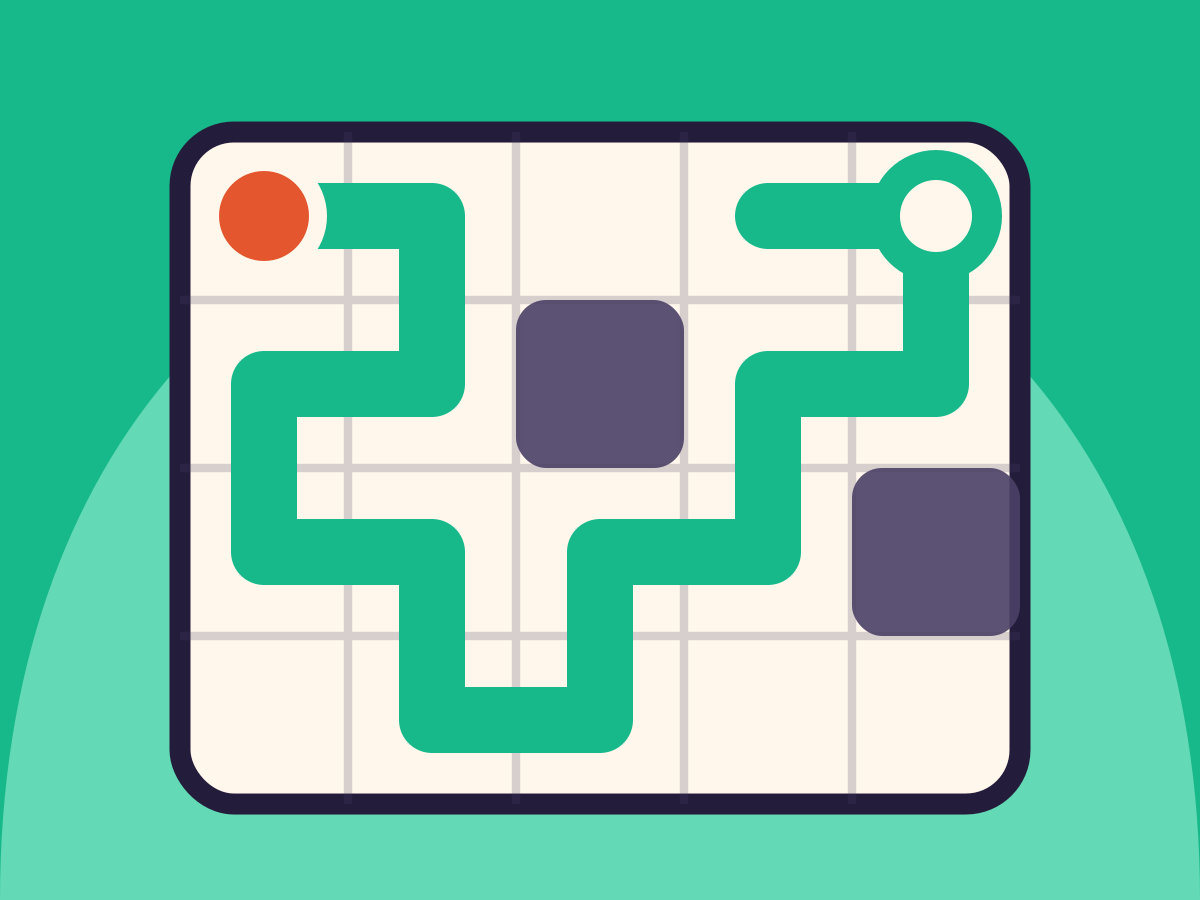
A free line puzzle that runs in your browser. One square carries a mark. From there you draw a single unbroken line through every open square on the grid, never crossing yourself and never using a square twice.
- Free
- No ads
- No account
- No download
- Works offline
- Single player
How do you play?
- Start on the mark - One square wears a ring. The line is already there, and it cannot begin anywhere else.
- Move one square - Each further touch steps one square sideways, up or down. Diagonals do not count, and walls never do.
- Never twice - A square the line has already used is refused. The board gives a small shake and nothing moves, so a misjudged touch costs nothing.
- Step back - The button under the board removes the last square. Touching the square you came from does precisely the same thing, one at a time.
- Cover it all - The board is finished when the line holds every open square. One empty square is enough to leave it unfinished.
About this game
The line is already standing on the marked square. Touch the square beside it. Then the next one. Keep going until nothing is left bare.
The board is not scattered and then hoped over. It is made backwards, and the order of operations is the whole trick. A walk is drawn first, one that visits every square of the rectangle exactly once, and then it is stirred rather than searched for: on the hard grid it folds 6,813 times, and each fold leaves it still visiting every square once. Only then do the walls come out, and they come off the two ENDS of that walk rather than out of the middle of it. What is left is therefore still one unbroken line over exactly the squares that remain, and the marked square is where that line begins. An answer exists before the board is drawn, and nobody had to go looking for it to know that. The column counting boards still sitting on the starting zigzag reads 0%, and it is there to stay that way.
Three grids, and the count of open squares is the real measure. Easy leaves 23, medium 30 and hard 38, which is 77.6% of the board once the 11 walls are in. Every open square takes exactly one step to cover, so every answer to a hard board is 37 steps long. No shorter, no longer.
Walking into whichever square happens to be free almost never works. A bot doing that finishes 6.3% of hard boards and leaves the board 60% covered. Always aiming for the tightest square instead, the one with fewest free neighbours of its own, finishes 50.7%.
Now the admission, measured rather than guessed. Some squares have only one open neighbour, which means the line can enter them at the very end or never at all, and 40.6% of hard boards hold at least one. Nothing marks them. There is no hint button anywhere and the board gives no warning as you walk past the last chance to take that corner; it simply stops accepting taps some twenty squares later, when the line has run out of room and the reason is far behind you.
What does it teach?
Covering with no gaps
Filling a surface without missing a square and without using one twice is a piece of geometry this game puts under a finger long before anyone can name it.
Looking before moving
The line has to be decided slightly in advance or it jams. After a few boards a child counts a square's free neighbours instead of following their own finger.
Undoing calmly
Nothing here is final. One step back, then another, and the line sets off somewhere else with nobody having lost anything.
Counting for real
Knowing six squares are left and that four of them sit in one corner is arithmetic, and it pays off within the second.
Tips
Tightest square first
Given two directions, take the one leading to the square with fewest free neighbours. That rule alone finishes 50.7% of hard boards against 6.3% for wandering.
Dead ends go last
A square with a single free neighbour can only ever be the end of the line. On 40.6% of hard boards there is one, so find it before your first step.
Eat the edges early
Border squares touch fewer neighbours, which means fewer chances to come back for them later. Taking them first leaves the middle open, and the middle forgives.
Never cut the board in half
A line running from one side clean across to the other leaves two separated halves. The line can only visit one of them, and the other stays bare whatever you do next.
A step back is not a failure
The back button costs nothing at all and appears nowhere in the record. Plenty of good boards get finished after three or four of them.
What age is it for?
5 to 6
The 5x5 grid with 2 walls. Twenty-three squares to cover, and the opening ring is visible from across the room.
7 to 9
The 6x6 and its 30 open squares. Six walls are enough to make corners that have to be planned for.
10 and up
The 7x7, 38 squares, 37 steps. The order you swallow the corners in decides the whole ending.
Grown-ups
A hard board first try, without a single step backwards. That is rarer than it sounds.
Accessibility
Every open square is a real button that announces its own row and column, and a touch alone does everything in the game. Dragging is a shortcut rather than a condition, which matters for a small hand that does not aim well yet and for anyone on an alternative pointer. Enter and the space bar advance the line exactly as a finger does, so a whole board can be played from the keyboard. The line is one colour throughout, so nothing here depends on telling two hues apart. A move that is not allowed answers with a small shake instead of an error sound, because a refusal is not a telling-off. The back button stays pressable even when there is nothing to remove.
Playing together
Take turns
One square each, in turn, on the same line. You find out quickly that the other person just closed the way you were heading.
Say it before you touch it
Call out where the line is going next, then go. A child who can answer that is playing the game rather than following their own finger.
Hunt the dead ends
Before you start, look together for squares with only one free neighbour. There are some on 40.6% of hard boards, and they decide the ending.
Two devices, one clock
The same level each on your own device, then compare the times. The boards differ; the length of the answer does not.
Common questions
Is every board really solvable?
Yes, and it is built rather than tested. The walls are taken off the two ends of a walk that had already visited every square, so what remains is still a complete line.
Do I have to finish on a particular square?
No. Only the start is marked, so any line that covers everything wins, even one that looks nothing like ours.
What do I do when the line gets stuck?
Go back with the button, one square at a time, until you reach a place where another direction opens. The restart button gives you the same board, empty.
Do I have to drag?
No. Touching square after square does exactly the same thing, and so does the keyboard.
How many steps is a good score?
Always the same number: 22, 29 or 37 depending on the grid. What separates two players is the time, not the count.
Is it free?
Completely. No payment, no advertising, and nothing to sign up for.
Does it work offline?
Yes, after one visit. A board in progress comes back as you left it if you close the tab.
How is the record measured?
In time, where faster wins, and separately per grid. A 5x5 and a 7x7 are not the same achievement.