Escape the Jam
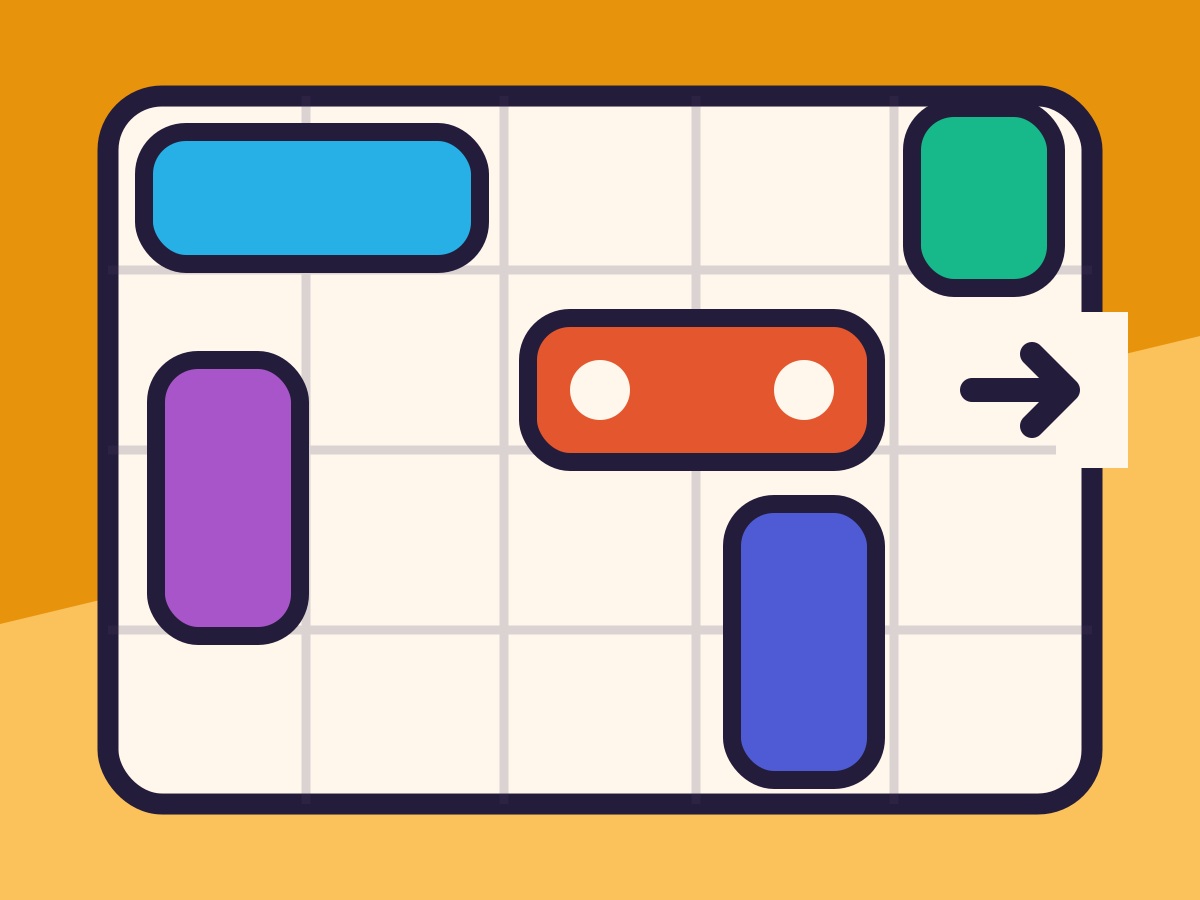
A free car park puzzle that runs in your browser. Six squares by six, every car locked to a single axis, and yours is the orange one that has to reach the gap in the right-hand wall. Three levels, unlimited undo, and the record is the fewest moves you managed.
- Free
- No ads
- No account
- No download
- Works offline
- Single player
How do you play?
- Pick a car up - One tap lifts it. The dots that appear are exactly the squares it can reach, no more and no fewer.
- Slide it - Tap a free square in line with it. The car's nose stops on the square you touched, and a tap off its axis just makes it twitch.
- Change your mind - Tapping a different car picks that one up instead. Tapping the car in your hand puts it down. Neither counts as a move.
- Get out - The orange car has to reach the right-hand wall on the row with the gap in it. The second counter tracks how many cars are still across the lane.
- Step back - Undo takes back one slide per press, as many times as you like, and the move counter comes back down with it.
About this game
Tap a car. It lifts. Dots appear on every square it can reach, and tapping one drives it there. That is the whole control scheme.
The interesting question is how short the way out really is, so it was measured rather than guessed. A breadth-first search over the real position space of 400 dealt boards per level returns the true minimum instead of an estimate of it: 4.2 moves on easy and 5.4 on hard. Before those numbers sound small, look at what counts as a move. A tap sends a car all the way to the square you touched, so crossing four squares costs one move rather than four, where the classic wooden traffic-jam puzzles count one move per square. A fifteen-move board in that unit is roughly five in this one, and mixing the two up is the easiest way to misread everything else here. The walk that built the board is a different story: 56.1 steps on easy and 73 on hard, about thirteen times the shortest line.
Some of that traffic really is scenery. A shortest solution moves 5.3 of the 12 cars on hard, so about seven are never touched. A bot sliding uniformly at random does eventually escape 85% of hard boards, taking 122.9 moves when it manages it. Your first board will land nearer that number than the other one.
The admission. Nothing here tells you what the shortest line was. Finish a hard board in fifty moves and the confetti is exactly the same confetti, because the game keeps one number per level and only ever compares it with your own. No par is printed anywhere, there is no star rating, and there is no hint button. The only way to find out whether a board had a five-move answer is to undo back to the deal and look again.
You cannot wedge this. Every slide is reversible, so any position you reach still offers at least the move that got you into it - 480,000 positions walked, zero dead ends. Undo brings the counter down with the car.
What does it teach?
Sorting what matters from what is loud
Twelve cars on screen and five that decide it. Looking for what is genuinely in the way instead of scanning everything is a habit worth far more than a drawn car park.
Chaining two ideas
Clearing the blocker sometimes needs another car pushed aside first. Two linked moves is a child's first real piece of multi-step reasoning.
Being wrong for free
Undo is unlimited and costs nothing. A child who knows no tap can break anything tries far more of them, which is precisely what is being asked here.
Axes
A car lying down never climbs, a car standing up never shifts sideways. That single rule is the whole geometry of the board.
Tips
Read the lane first
The second counter says how many cars stand between you and the gap, usually one to three. Every one of them has to move at least once and so do you, so that number plus one is the floor under your own solution.
Ask where the blocker can go
A vertical car needs a free square above or below it. When both are taken the question becomes who will free one, and that is where three-move boards start.
Do not tidy the car park
Moving a car because it looks badly parked costs a move and buys nothing. Ten of the twelve never move in the best line.
Replay the same board
Undo reaches all the way back to the deal. Cutting a board you have already finished down to three moves teaches more than ten fresh ones.
What age is it for?
4 to 5
Easy, six cars. The generator refuses any board that comes apart in under four moves, so even the gentlest one asks for a short sequence.
6 to 8
Medium, nine cars. Enough traffic that the blocker has to be found, not enough to put anyone off.
9 and up
Hard, twelve cars. The fun moves from getting out to getting out in five moves rather than fifty.
Grown-ups
A hard board closed in five or six moves is a board that was read properly. The worst of 400 needed eleven.
Accessibility
Everything is a tap, never a drag, and every square of the car park is a target of the same size whatever happens to be parked on it. The player's car is not identified by colour alone: it carries an arrow pointing at the exit and a heavier outline, for a child who cannot easily separate the orange one from the blue ones. There is no clock and no move limit, so a tablet can be put down in the middle of a thought. An impossible slide answers with a small shake and no error sound, because a refusal is not a telling-off.
Playing together
One move each
Take turns on the same board. The shared counter makes a wasted move visible to everybody, which is all it takes to start an argument worth having.
Say it before you tap
Name the car that is in the way and why, out loud, before moving it. A child who can answer that is reading the board rather than drumming on it.
Bet on two
Guess together whether the board closes in exactly five. On hard it does 73.8% of the time, which makes the bet fun mostly when you lose it.
Same level, two devices
Everyone plays their own deal and the move counts get compared at the end. There is no clock, so nobody is hurrying.
Common questions
Is every board solvable?
Yes, and it is built rather than tested. The game starts from the finished position and walks away from it in slides that a legal slide puts back, so the route out exists before the board is drawn.
Can you get stuck with no legal move?
No. Every slide is reversible, so any position keeps at least one legal move. We walked 480,000 positions and found no dead end.
How many moves is a good score?
The true shortest solution averages 4.2 moves on easy and 5.4 on hard, and the generator refuses anything under four on easy or five on hard. Reaching that floor is as good as a board allows.
Does undo hurt my record?
No. The counter drops by one on every step back, because a move you took back is not a move you made.
What is the difference between easy and hard?
The number of cars, six against twelve, on the same six by six car park. The shortest solution lengthens only a little: 4.2 moves against 5.4.
Is it free?
Completely. All three levels, no payment, no in-game purchases and no bigger paid version.
Are there ads?
None. No banners, and nothing playing between boards.
What age is it for?
About four and up on easy. Nothing has to be read in order to play, so a child who cannot read plays alone.