Way Home
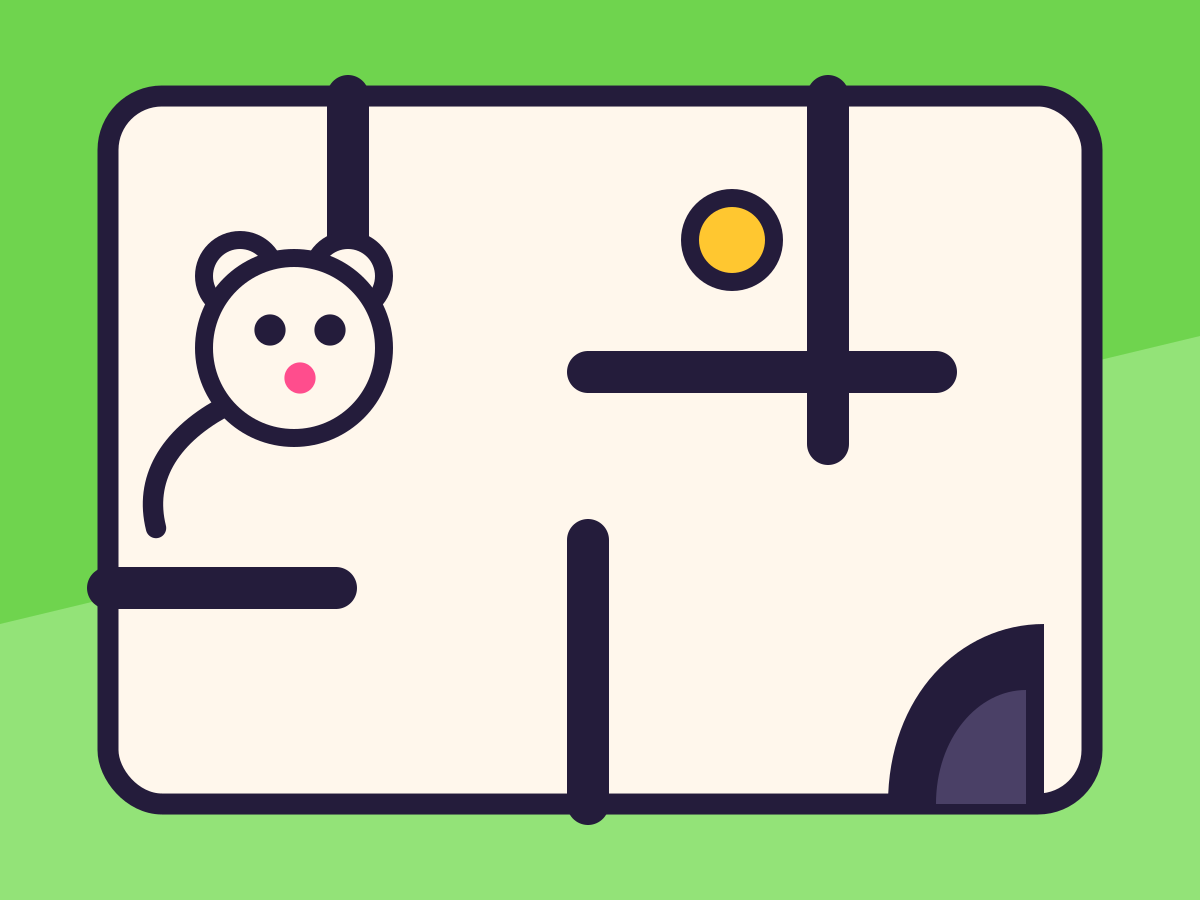
A free maze game that runs in your browser. There is a mouse, a few crumbs and a burrow, with hedges in between. Steer the mouse through the hedges with the arrows, one square at a time, picking up whatever it passes. Collect them all, get home, and the next maze arrives on its own.
- Free
- No ads
- No account
- No download
- Works offline
- Single player
How do you play?
- Pick a board - Five by five with two crumbs, six by six with three, seven by seven with four, or the expert ten by ten with six.
- Look at all of it - Everything is visible from the first frame. Nothing is hidden, so nothing has to be hunted.
- Steer with the arrows - Each press moves the mouse one square, and never once through a hedge.
- Collect on the way - Any crumb the mouse walks onto is picked up, whether or not you were aiming at it.
- Head for the burrow - Once the crumbs are gone, walking onto the burrow closes the maze and the next one deals itself.
About this game
Nothing moves until a child presses an arrow. Nothing here can go wrong. Walk a silly route and the maze still ends at the burrow, it is simply not a perfect one, and only perfect runs feed the record.
Which leaves exactly one thing worth being good at: the order. We dealt 20,000 fresh mazes at each board size and compared every deal against its own shortest possible run, brute-forced over every order of the crumbs. Walking to the nearest crumb first, which is the move everybody makes, matched that shortest run on 92.7% of the small boards and on only 68.6% of the seven-square ones. Take them in reading order instead and it falls to 44.6%. And on that board the worst order of the same four crumbs costs 84.35 steps against a shortest run of 39.53, so deciding is worth more than the entire walk.
There is a fourth board for anyone who has run out of maze. Ten squares to a side, six crumbs, and cut a different way: the other three grow one long corridor at a time, this one branches from everywhere at once. That leaves 32.94 of its 100 squares as dead ends against 5.92, par at 52.78 steps, and the nearest-crumb mouse down at 33.0%.
The arrows move the mouse one square per press. You steer the whole way. The route is yours. Nothing at all is held down.
Now the part worth knowing before you hand it over. The small board is barely a maze. It is carved properly and then nine out of every ten dead ends are opened back up again, which leaves about a third of one dead end on an average deal, and in one deal out of ten every order of the crumbs costs exactly the same number of steps. That board is a garden with hedges in it, and it is meant to be. A three-year-old needs precisely that. An eight-year-old will be done with it inside a minute, so do not start them there.
What does it teach?
Ordering a job
Four crumbs is 24 possible orders and most of them are longer. That is about as much choice as fits in a head.
Reading a space
Before the step you have to see that a route exists. Small-scale map reading, with no words in it.
Pausing before acting
Nothing moves until you press an arrow, so a second of thought changes the result immediately. That is rare in a game children actually like.
Living with imperfect
A wandering maze finishes exactly like a tidy one. Nobody is punished, and the next deal is right there.
Tips
The nearest crumb is not always first
It is the obvious move, and it misses the shortest run on a third of seven-square deals and two thirds of expert ones. Look where the second crumb sits before setting off for the first.
Find the burrow early
Every run ends there, so a crumb lying in that direction is nearly free. One in the opposite direction wants collecting while you are still out that way.
Two crumbs, one walk
Crumbs on the same corridor come home on one straight walk. Before you take the near one, check whether the far one is straight past it.
Watch the lit trail
The route stays lit for a moment after each step. That is where a detour becomes visible, and it teaches more than anything else on the screen.
What age is it for?
3 to 4
The small board. Two crumbs, few hedges, and nearly every step moves something along.
5 to 6
Six by six with three crumbs. The shortest run averages 24.41 steps, which is where order starts to pay.
7 and up
Seven by seven: four crumbs, close to six dead ends per deal, and a perfect run that wants the whole board read.
9 and up
The expert board. Six crumbs is 720 orders to pick from, and a third of the hundred squares is a dead end.
Grown-ups
Go for a streak of perfect runs. Our nearest-crumb bot manages 68.6% on the seven-square board and 33.0% on the expert one, which is a fair thing to measure yourself against.
Accessibility
The arrows are big single-tap targets, not a gesture that has to be held, and each press moves the mouse one square. Arrow keys work too. There is no clock and no countdown, so you can stop and think for as long as you like. No square is ever tapped, so a square is a picture rather than a target: around 49 pixels on the seven-square board and 34 on the expert one on a 390 pixel phone. Every square is labelled with what is standing on it plus its own column and row, so a screen reader can tell a hundred of them apart instead of reading the same thing a hundred times. The whole game plays in silence without losing any information.
Playing together
Point before you go
Ask which crumb goes first, then let them steer. A small child answers that with a finger, and that is already a plan.
One maze each
Take turns, a whole maze at a time, and count how many came out perfect. No clock, so nobody is hurried.
Guess the number
Before you start, guess how many steps it will take. Compare it with the counter afterwards.
Say where it has been
The mouse remembers nothing, so the story is yours. Who lives in the burrow, who dropped the crumbs, and why.
Common questions
Can you lose?
No. There is no clock, no lives and no move that ends badly. A wandering walk still finishes at the burrow, it just does not count as perfect.
Can I choose which way the mouse goes?
Yes. The arrows move it one square at a time, so the whole route is yours. To go around a hedge, just steer the mouse around it step by step.
What counts as a perfect maze?
One finished in the fewest steps that maze allows. We work that minimum out per deal against every possible order of the crumbs, so it really is the minimum.
How many steps does a maze take?
The shortest run averages 13.58 steps on the small board, 24.41 on the middle one, 39.53 on the seven-square one and 52.78 on the expert board, over 20,000 deals. A mouse that always heads for the nearest crumb finishes the seven-square board in 43.91 and the expert one in 60.92.
Is the small board too easy?
Yes, deliberately. Nine in ten of its dead ends are opened back up, and in a tenth of deals every order costs the same. It was built for a three-year-old rather than an eight-year-old.
Is there an undo button?
No, and none is needed. No move can ruin a maze, only lengthen it. Restart deals a fresh board whenever you want one.
Does a child need to read?
Not a word. A mouse, some cheese and a house is the entire vocabulary. The row under the board shows the crumbs left as crumbs rather than as a number.
Is it free?
Yes. No payment, nothing to buy inside the game, and no larger paid edition.
Are there ads?
None. No banners, and nothing playing between mazes.
Do I need to download or sign up?
No. It runs in the browser, and after one visit it is stored on the device and works with no signal.
How is the record measured?
By how many perfect mazes were finished in a row, kept separately for each board size. One wandering maze resets the streak and takes nothing else away.